A voice from Gaza : Islam
Thanks to Islam for being willing to share his story with us and for placing his trust in me.
You’ll find the donation page below :
I am Islam Radwan, a widow from gaza. My husband died in the war, and I have 3 children left. In the 34 years of my life, I have witnessed 5 brutal wars and many escalations. Since I was a child, we have been suffering from a financial crisis and poverty, and many nights we have slept without food.
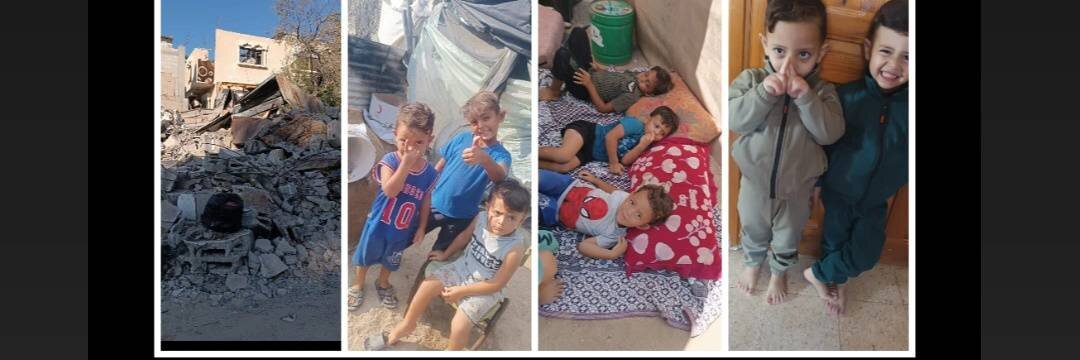

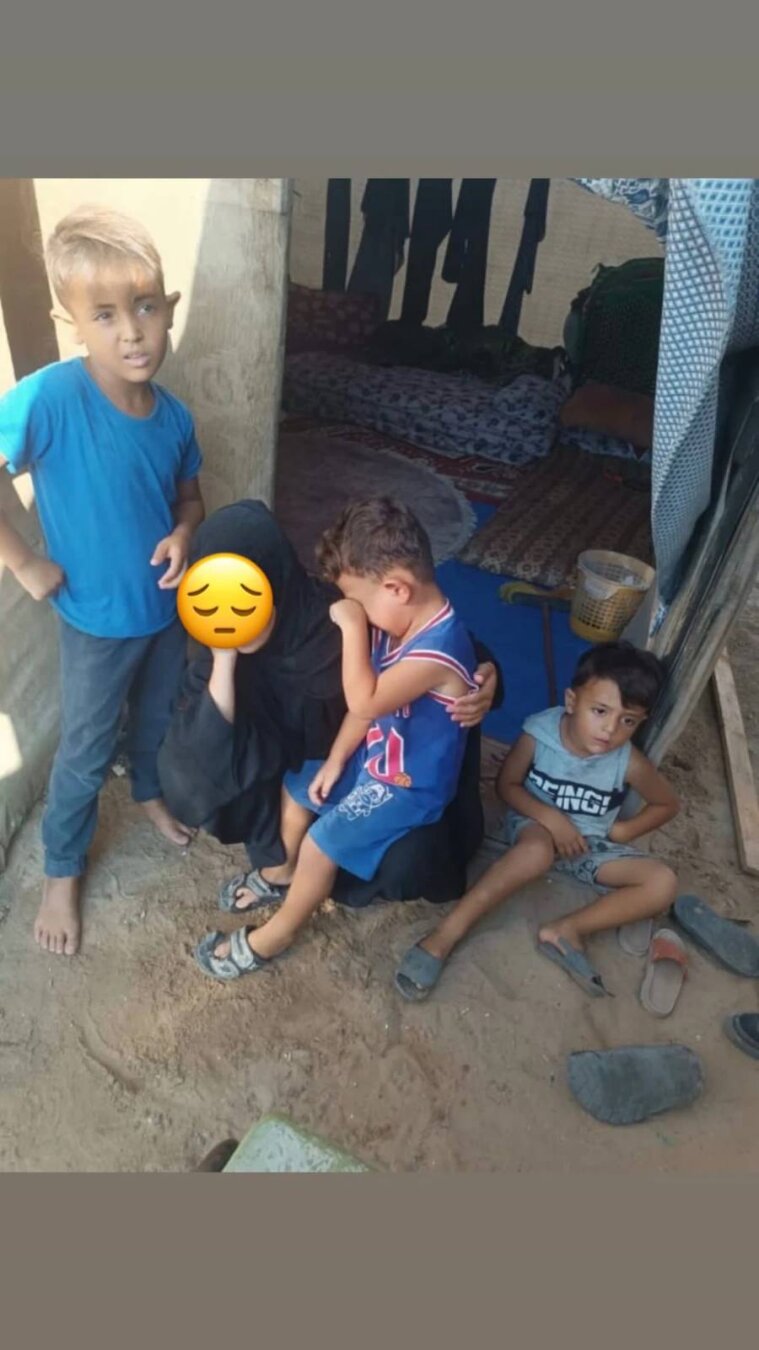


In the past period, we have seen a slight improvement in our living conditions, but since the beginning of the war, the destruction has been raging in Gaza. Our source of livelihood, my work…
With the war, all our dreams and ambitions are over, and we are now staying in tents that are not enough to repel any wind or hail. In addition to our displacement, we are facing a dramatic rise in the cost of living, which makes it difficult to leave Gaza, due to the enormous rise in the cost…
Also, don’t forget to help us even with something simple in this difficult situation, and the high prices of all commodities helps us to meet our daily needs and expenses.
I got married at the age of twenty and I have 3 children without a father. Our dreams of building our house and raising our children well ended because of the brutality and barbarism of the war. We lost everything. Now I don’t have the money to buy the most basic elements of life for them.
Help me for my children and to rebuild our home I ask you to help me build our home and save my life and the lives of my children, my family and my loved ones from this
Question and Answer
Hello Islam, and thank you for agreeing to answer these few questions so we can get to know you better.
This “interview” will be divided into 4 sections: Life in Rafah before, the turning point, the present, and a conclusion.
Life in Gaza
1/ How would you describe life in Gaza before you were forced to leave, for people who have never been there?
Gaza is not merely a geographical location; it is a state of being. It is a city perched by the sea—a sea that served as the sole outlet and a sanctuary offering respite from the harshness of daily life. Life there was defined by deep-rooted simplicity and profound social cohesion; within its alleyways, neighbors knew one another, and relationships were forged over many years, creating a spontaneous social support network that made the individual an integral part of a greater whole. It is difficult to describe Gaza without noting its contradictions: in a single day, one might encounter the morning calm of the waves, the bustle of markets teeming with vendors and shoppers, and the laughter of schoolchildren—all while a sense of anticipation, mingled with hope for a better future, always loomed on the horizon. Life there never came to a halt; it defied it. Every moment was lived with a keen awareness of its value, and clinging to the small details—a morning cup of coffee, family gatherings, or the sight of the sunset—was what gave life meaning amidst such hardship. In short, Gaza was and remains the embodiment of “life in the direst of circumstances”—a city that does not merely survive but insists on sowing beauty and hope in every corner, holding fast to a strong, unwavering cultural and social identity.
2/ How old were your children when you had to leave? Did they realize what was happening around them?
Islam was just turning six, Yahya was four, and Muhammad was three. Yes, they were fully aware of their surroundings and constantly surrounded by fear; my warm embrace was the only refuge where I could shield and soothe them.
3/ What is your educational and professional background?
I completed my secondary education, graduating with an average of 72%. I also studied Basic Education at university for two years but was unable to complete my studies due to the war.
4/ What was the school your children attended like? UNRWA ?
No one attended school; the war came, and they did not study. It was only a year ago that my eldest son, Islam, enrolled in a school—an UNRWA-affiliated one called Ma’aref Mazoun—in Al-Mawasi, Al-Qarara.
5/ What were their favorite subjects in school ?
I am laying a solid foundation for them because they are young; Yahya and Muhammad are in kindergarten. As for Islam, mathematics is his favorite subject.
6/ Do you still have any family, besides your children ? Are you still in touch with them ?
I have only my children, whom I care for on my own. I dedicate all my time and effort to them, they have no other support. I rely on donations to provide for their basic needs.
The turning point
1/ When did you realize you had to leave? What was the trigger?
Leaving was not a choice but a necessity imposed by the escalating situation, which rendered remaining in Rafah intolerably dangerous. The turning point came as the margin between safety and death shrank with every passing hour, and you realized that protecting your three children and ensuring their basic safety required making this difficult decision; the family’s well-being was the sole, driving force behind this move.
2/ How did your departure from Rafah unfold? What were you able to take with you?
Leaving Rafah was a journey fraught with danger and confusion. Amidst the chaos and the scarcity of transportation, you were forced to rely solely on what you could carry by hand. In those moments, the focus was on absolute essentials: vital identification documents, a little food and water, and basic clothing for the children. You left behind not merely material possessions, but memories and the details of an entire life—clinging to the enduring hope of return.
3/ Under what conditions did this departure take place?
The departure took place under extremely difficult conditions, marked by unsafe roads, severe congestion, and a scarcity of fuel and transportation. The journey unfolded amidst ongoing shelling and security threats, necessitating constant vigilance and extreme caution throughout the trip, alongside indescribable psychological stress and a continuous effort to keep the children calm amidst the terror.
4/ Did you receive any help?
We did not receive any financial assistance. The strength of family and social solidarity often came to the fore; I relied on the support of family and relatives—such as my siblings—to coordinate movements or provide urgent information regarding the safest routes. Help often came from others undergoing the same experience, with everyone sharing information and basic logistical support to navigate the crisis. Ultimately, family cohesion served as a bulwark that mitigated the severity of the ordeal.
The present
1/ How is the camp organized today? What exactly are you living in?
I do not live in an organized camp; instead, I rented a plot of land and set up my tent there. This is the third location I have occupied in a row; the landowners are greedy—they evict people and demand rent.*
2/ Is there any financial assistance available, or do you rely solely on donations to buy things?
We rely entirely on donations. Every three months, the World Food Programme provides us with a sack of flour, a carton of canned goods, and a kilogram and a half of biscuits.
3/ What are the prices for basic necessities and hygiene products, as well as food?
Prices for basic goods are extremely high, including cleaning supplies, which we can barely afford to buy. Food prices have dropped somewhat compared to before, but my children crave fruit; I cannot buy it, nor can I even look at it, and I am too embarrassed to ask the price because I simply do not have enough money.
4/ What can you buy where you are?
I am currently in an area called Mawasi Al-Qarara. There is a supermarket offering a wide range of goods, but I do not buy many of them because they are too expensive; there are also many roadside stalls. I can only afford to buy vegetables, some legumes, and basic necessities.
5/ Do your children have internet access for their studies?
My children are young and don’t even have phones. The oldest is 8 and the youngest is 5. As I mentioned before, my eldest son attends a UNRWA school. They don’t use the internet; I am the only one who uses it.
6/ Is there mutual aid in the camp, and how is it organized?
Yes, mutual solidarity is the last line of defense. It is organized through simple, self-initiated efforts: Sharing the meager food available among neighbors. Cooperating to fetch water from distant distribution points. Neighboring families caring for children who have lost their loved ones. It is a form of solidarity (both emotional and material) to the extent that harsh conditions allow.
7/ How are your daily lives organized in the camp?
Morning: Begins with searching for water—whether for drinking or washing—and standing in long lines to obtain bread or aid. Daytime: Most of the time is spent trying to secure food or repair the tent (often torn by the wind or sun). Night: Trying to stay safe amidst harsh weather conditions and pitch darkness.
Every day is a repetition of these arduous tasks, where life is reduced to “securing a livelihood” and “seeking safety.”
Conclusion
If you could speak to everyone, what would you say to them?
If I could speak to everyone at once, I would remind them of a truth often lost amidst the clamor of individual conflicts and global crises: the power of our shared humanity. In a world that frequently focuses on what divides us—geography, circumstances, and ideologies—I would say this: The Value of Presence “You are not merely observers of history; you are the authors of the next chapter. Even in the harshest of circumstances, the simplest acts of kindness—sharing a meal, a moment of listening, or simply choosing to help a neighbor—are the building blocks of a better future. Never underestimate the weight of your compassion.”
Empathy is not a weakness; rather, it is one of the most sophisticated tools for survival. When you choose to view the world through the eyes of someone whose life is vastly different from your own, you break the cycle of misunderstanding. We are all bound by the same fundamental needs: the need for safety, the need for dignity, and the need for others to see and understand our suffering.